
I’ve been working on slides for a possible Facebook ad today, just submitted for review. They’re photoshopped from publicly-available NASA images and photos I’ve taken. Feel free to tell me what you think!
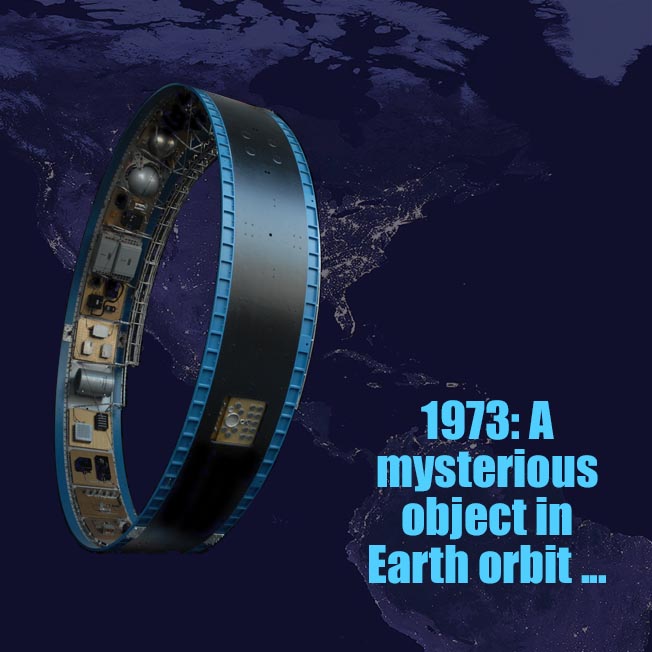


I’ve been working on slides for a possible Facebook ad today, just submitted for review. They’re photoshopped from publicly-available NASA images and photos I’ve taken. Feel free to tell me what you think!
I don’t know about you, but when I was a kid, I looked forward to Book Fair Day at school like nothing else.
The elementary school gym would be spread with tables, and you and your parents could peruse the Scholastic Books titles at your leisure (though your chance probably only came during one period of the day).
The process was streamlined later with four-color flyers sent home so you could order your books and they would be delivered to the school.
Recently, I re-evaluated how I’d describe the Retrowater Cycle while marketing the trilogy online. Romance? Science Fiction? History? Fantasy? Time Travel/Paradox? Mystery? Paranormal? Young Readers?
Of course, there’s a little of all of that going on in them. It made them tough to classify on Amazon!
But the thought that kept coming to mind was: I want them to be Scholastic Books for grown-ups.
Something that’s a little challenging to heart and head; that hits the thinks and the feels; that piques curiosity and hopefully makes you care enough about the characters to pursue the mysteries with them.
There are strong female characters. There are strong male characters. There are people of strong character! And many of them are regaining their youth and dealing with loss. So of course there are conflicts and differences of opinion and unresolved passions.
But they’re also generally kind, caring and intelligent people, who make the attempt to resolve problems and differences without a lot of self-centered drama. (Generally! — And some find out that doesn’t help!) People don’t have to be mean-spirited or driven by evil to have or create conflicts.
There’s no need to drag readers through salacious details of personal matters, and that’s the beauty of writing in the first person. Most people would not be that overly honest.
Besides, sex and romance are almost always more vivid in the reader’s experience when suggested rather than spelled out in every detail!
And if young readers enjoy them too, there’s nothing that their teachers or parents or individual consciences have to be concerned about.
So that’s how I’d characterize the kind of books they are:
Scholastic Books for Grownups.
Start me a new category on Amazon.
Another kind note from a friend on Facebook:

At one point in the story of The Water Cure, two of my characters discuss a phenomenon they have seen with their own eyes, and dismiss fireflies as an explanation for it. Fireflies, as everyone knows, glow yellow-green; not blue.
Well, in fact, there is a species of firefly that glows blue. But it is not indigenous to the Ozark Mountains where my characters encounter that light. It’s found, instead, in the Great Smoky Mountain range — close to where one of those two characters was born!
Read about rare “Blue Ghost Fireflies” in this article from Discovery Magazine:
https://www.discovery.com/nature/rare-blue-ghost-fireflies-only-glow-in-one-part-of-north-america
My Facebook friend Ora Howard Davis posted this favorable review on her page ….

I started writing The Water Cure with a pretty firm grasp on my characters and story. The main character and narrator would be Anne, a no-nonsense doctor and former schoolteacher from Cherokee, North Carolina; the others, her romantic interest Mac and his best friend Stan.
Anne was kind of humorless, all about her work; Stan was the dad-joke-loving comic relief. They would lose their treasured Mac and find a way to work together in all the unexpected decades to come. She had parted ways with her parents over her career change, and was struggling to deal with that loss as well as losing Mac.
The problem was that Anne was no fun to write, and no fun to read. She either didn’t get or didn’t appreciate Stan’s jokes. She was miserable from losing Mac and seemed dedicated to making Stan as miserable as she could while he was genuinely doing his best to help her find her life again after Mac.
It wasn’t working.
I needed a new approach.
And about that time, I met a couple of lovely young, outgoing women downtown who worked together, and guessed their ages (as one does) at about 32-36; something in that range. As it turned out, I think I was right about one, and — overhearing the other divulge her actual age to friends wishing her a happy birthday — I was a decade off and a little more!
It dawned on me that I had mis-guessed her much younger in the same way that other characters would be wrong about my main character — and that she had the charming personality that my main character needed.
I began re-writing. Stan became the humorless character, recovering from much more than the death of his best friend; his nature turned private and secretive. Anne’s name changed, and she became the strength that would help him recover as she did — even to the point of encouraging his latent sense of humor.
Later, as I wrote, and Stan’s character grew, I suddenly realized why Stan had been so secretive, so reserved, and so private about his grief — beyond the loss of his family when he was a young teen. My character surprised me! But once that truth about him came to me, there was no avoiding it. He had to be written that way.
And that worked.
This Northwest Arkansas TV station report from 2019 examines the regional legend of a “phantom caboose.”
Of course, if you’ve read The Water Cure, you know the phantom caboose was the one Stan bought from the Arkansas & Ozarks Railroad in 1960, just getting its bearings from its trip to 1910 and finding its way back to the barn on the family farm near Gaskins ….
https://youtu.be/NEHLi1vh5DQ
I admit I am having difficulty creating a fourth book in the “People of the Water” Cycle.
Possible events and threats and one mysterious character that are described in the third novel imply the probability of great evil in the future, and I do not know how to write evil.
Most of my characters are as baffled by evil as I am.
I have always thought of myself as a good person, and have always wanted to be one.
I don’t understand evil for the sake of evil, self for the sake of self, hate for the sake of hate, harm for the sake of harm, murder for the sake of murder.
But that is undoubtedly what would have to lie ahead in the Cycle.
It seems there is so much of it in literature, I wanted to write something different. But there is a lot of it in the world as well, and it would be a cheat to avoid it forever.
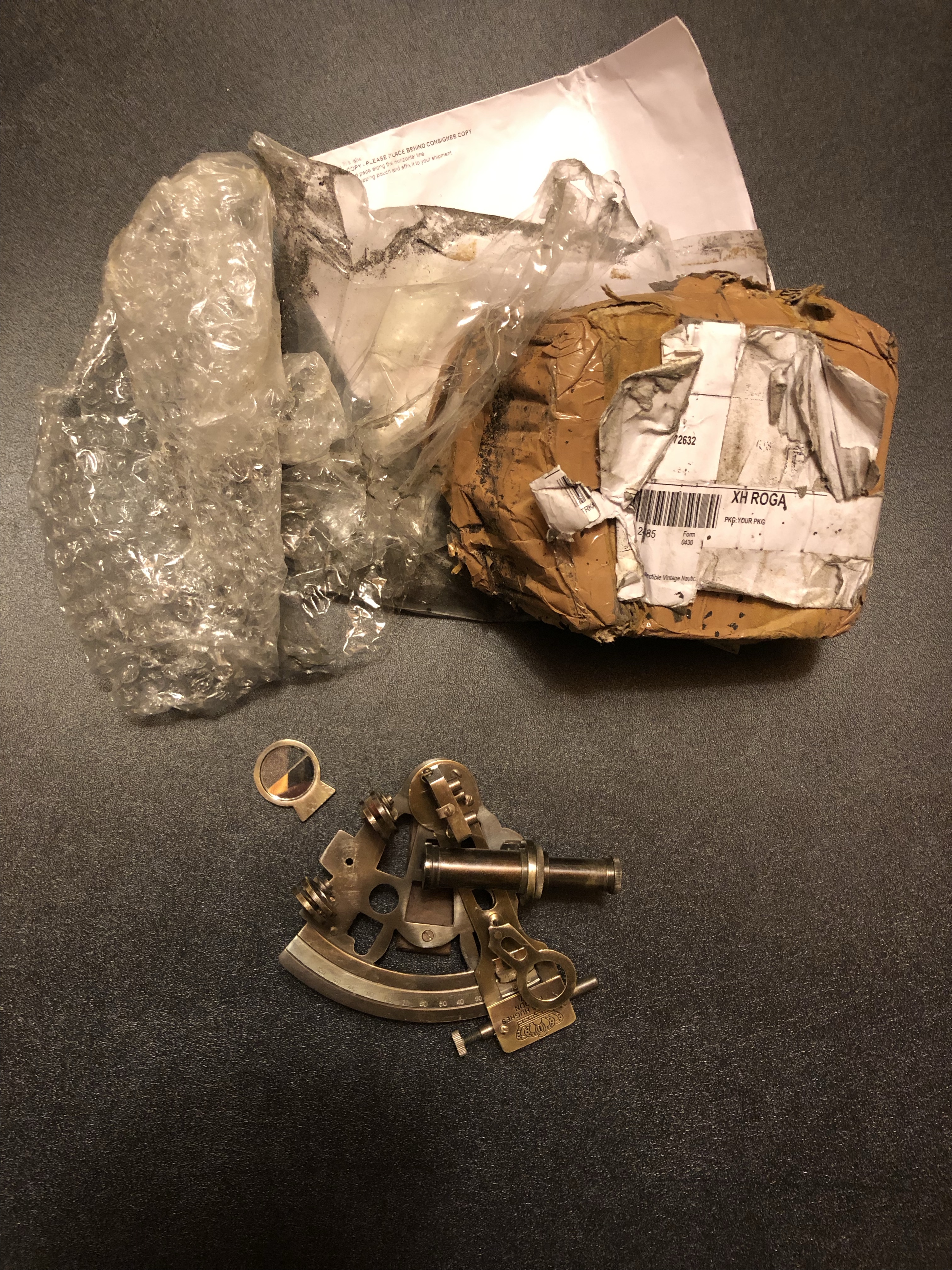
The saga of the lost sextant ended today.
The one I ordered in October finally arrived today, after making its trip from India to Memphis in only four days.
And it has been lost in the hands of FedEx ever since. I had given it up, ordered another, received it in less than a week and used it in the cover photos for my novel trilogy.
Although the old one arrived in the filthy, heavily damaged container above this morning, it was encased in layers of bubble wrap and the only broken piece was a sheared-off brass screw that holds the image splitter in place. Pretty sure I’ll find one that can replace it among my model railroading treasures.
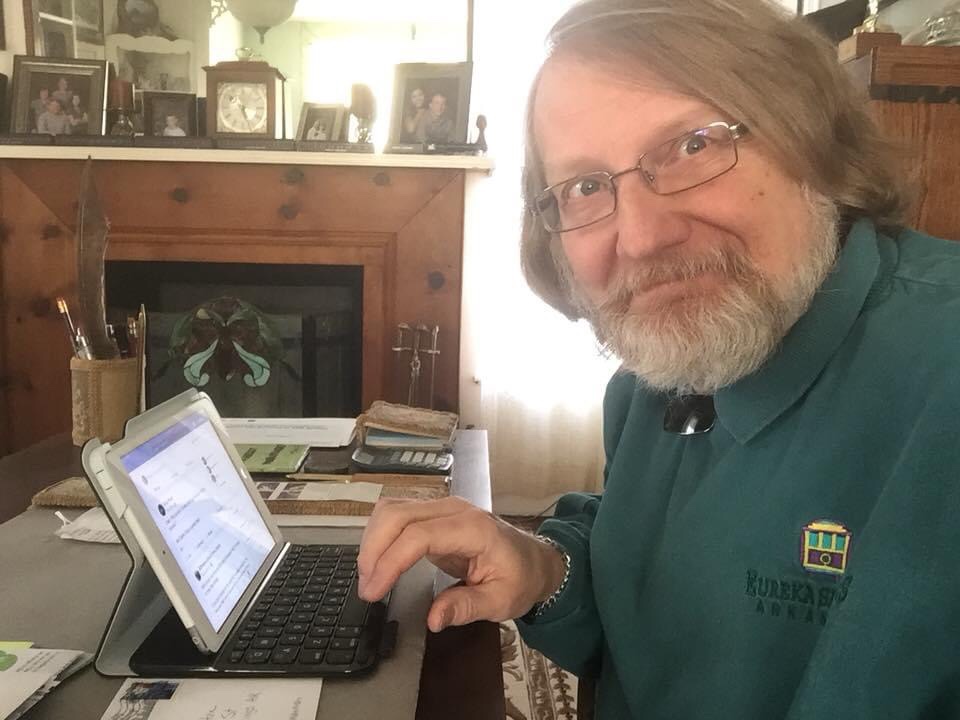
This is me, four years ago, shortly after buying that little Kensington keyboard/case for my iPad Mini. I ended up writing three novels on it with the free Microsoft Word app.
(Though when it came time to format the pages and build the books, I subscribed to the full Word app on my iMac.)
 W. Keith Brenton