I made good progress on the next chapter of Book 4, “The Unwept Tear,” thanks to a breakfast wrap with bacon and a classic latté at the venerated Mud Street Cafe this morning. Another couple of pages; another couple thousand words. About a third of the way there.
Maybe midway through Chapter 4. I’m trying to not give away too much with a glimpse.
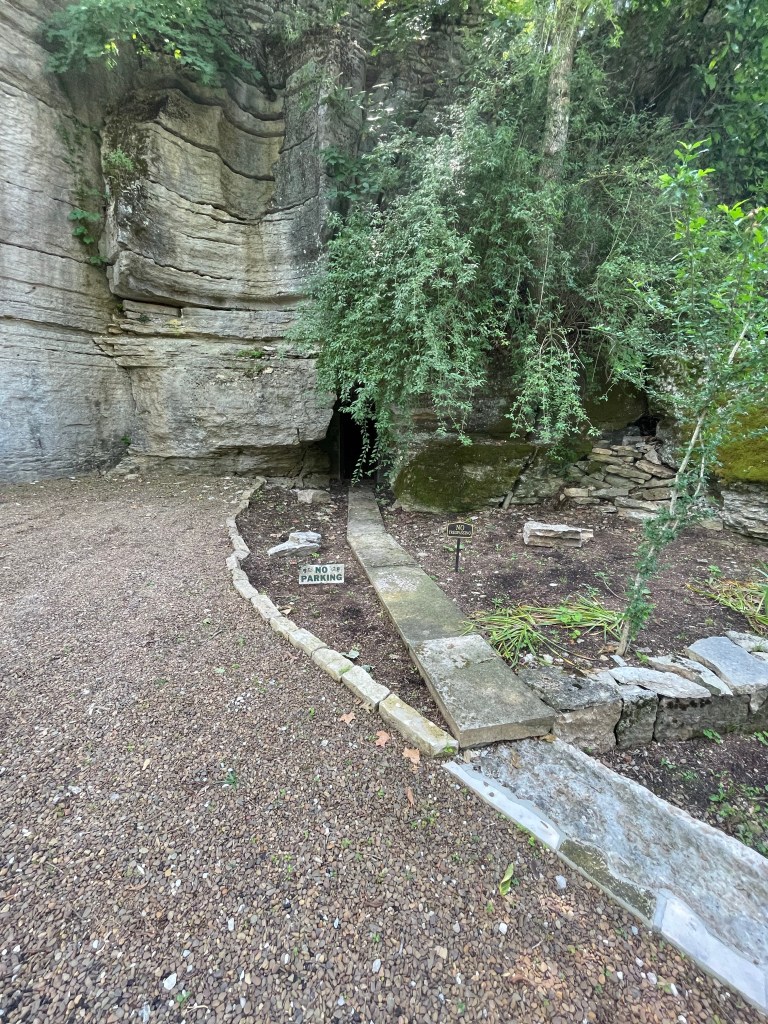
Carrie Nation Spring is not one of the city’s public spring reservations; it is on private property. So if you visit, please respect that. Local legend has it that alcohol abolitionist Carrie Nation — who lived across the street — saw the cleft in the rock and intuited that there must be a spring behind it, so she took her bar-chopping hatchet to it and water dripped forth. Carrie was a formidable woman, feared by many men (especially bar-owners), and is mentioned in a true anecdote in my first novel, “The Water Cure.”
Carrie, about to purchase a train ride to one of her public events, so startled North Arkansas Line ticket agent Ernie Braswell that when he turned and saw her, he nearly choked on his chaw.
Carrie Nation’s “Hatchet Hall” as you approach on Steele Street.The spring, approaching from the south.The gated spring entrance, almost obscured by a tree.Please be courteous if you visit. (Photo taken from the street, zoom lens.)Hatchet Hall was also once home to local artist-legends Louis and Elsie Freund. They were the drivers of the visual arts movement in Eureka Springs. A mural of the town that they painted inside this home has been removed and preserved in the Eureka Springs Historical Museum.
This article in the May edition of Discover Magazine details the identification of what was originally thought to be an asteroid as the top stage of the Saturn 5 and Saturn 1-B lunar rockets.
Just like the ones that lifted Skylab and the fictional Skylark mission to orbit in “The Water Cure,” Book 1 of the “People of the Water” Cycle.
Without teasing too much of Book 4, “The Unwept Tear,” suffice it to say that much of the action moves from Eureka Springs, Arkansas and the Gaskins community (north of it) to Beaver Lake, west of town and near the Busch community. There is a visit to Grandfather’s lodge in Cherokee, N.C. to be sure, but most of the “People of the Water” Cycle’s fourth volume will take place — as you might have guessed — on land surrounded by water.
Here’s a little introduction to Beaver Lake, which you would expect to have been created by a Beaver Dam:
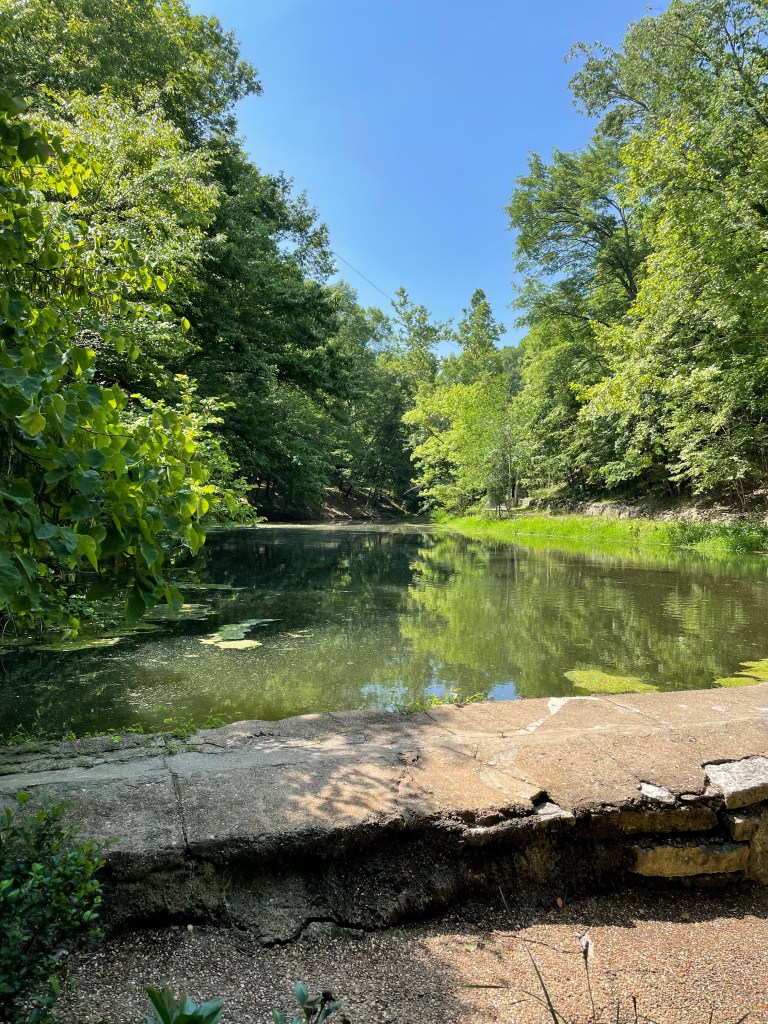
Little Eureka Spring, though I could find no markings for it, is a city spring reservation at the end of Steele Street where it curves into Douglas Street, just before Little Lake Eureka.
The spring-fed lake, created by a dam as a water supply more than a century ago, is now surrounded by private property and private drives, although it’s fine to visit the end of the lake with the low-walled stone dam.
(See video of the dripping spring water in the small cavelet.)
Though the spring and lake don’t factor into the “People of the Water” Cycle, you can imagine what it was like for this lake to serve as water supply and swimming lake when Eureka Springs was young and the first novel’s events took place.
Little Eureka Spring reservation“Mac” Weems was a colorful construction engineer who designed and built the superstructure of the Christ of the Ozarks statue, life-size dinosaur figures at the now-closed “Dinosaur World” near Busch, AR, and kept the steam locomotives of the ES&NA Railway running for many years.Little Lake Eureka; grounds tended by gardenersLucky landowners live on either side of this spring-fed lake.
I’ve referred to this cool legend of the M&NA Railroad before, in two different posts, Ghost Train and Phantom Caboose.
About half-way through “The Water Cure” — the first novel in the “People of the Water” Cycle — I quote a story reprinted in at least a couple of books about the North Arkansas Line’s history. I used to tell it when I was a conductor on the Eureka Springs & North Arkansas Railway, and it was told by my friend Conductor Jim yesterday when I rode with my five year-old grandson.
It’s reprinted from, I believe, American Railways Magazine (defunct) about an incident in 1906 that you could call the Tale of the Ghost Caboose. Here’s the brief story that appeared in the magazine:
Phantom trains have long been subjects for the most exciting fiction, but it is seldom that a well-authenticated instance of such apparitions occurs. A story from Eureka Springs, Arkansas, seems to fill the bill in this particular, however.
The engineer of a passenger train was about to slow up for the water tank at Gaskins, as was his custom, when he saw just ahead a caboose with the signal lights burning. He also saw the conductor come out of the cupola with his lantern and noted the burning fusee on the track.
He yelled to his fireman. The fireman glanced out of the window, saw the caboose, grasped the reverse lever, and helped his chief to throw it over; then both men dropped down to jump. But before they could go over, the caboose vanished, and the only thing left was the charred fusee on the track.
Fireman Harrelson had such a fright that he refused to go out next morning; and although Engineer Dobbins went out under protest, he recommended Master Mechanic Dolan to have everything in readiness, as there was sure to be a wreck somewhere.
But trains ran as usual, and if there was any object in the visit of the ghost train it has not been made clear yet. The account is supplemented by the statement that Agent Braswell, of Gaskins, also saw the phantom caboose and lights from his home.
Dobbins’ fear that the spectral caboose was the harbinger of disaster was not entirely unfounded. A few years later, in 1914, a collision between a North Arkansas motorcar (essentially a self-powered coach) and a Kansas City Southern train cost 43 lives near Tipton Ford, Missouri.
How all of that plays out in the novel, I won’t spoil here!
(Pictured: My 1/87 HO scale model of the wooden ES&NA caboose that resided on the pike for many years.)
If you follow Spring Street north from Crescent Spring, make the turn to the west at its northernmost bend, you’ll come to Grotto Spring.
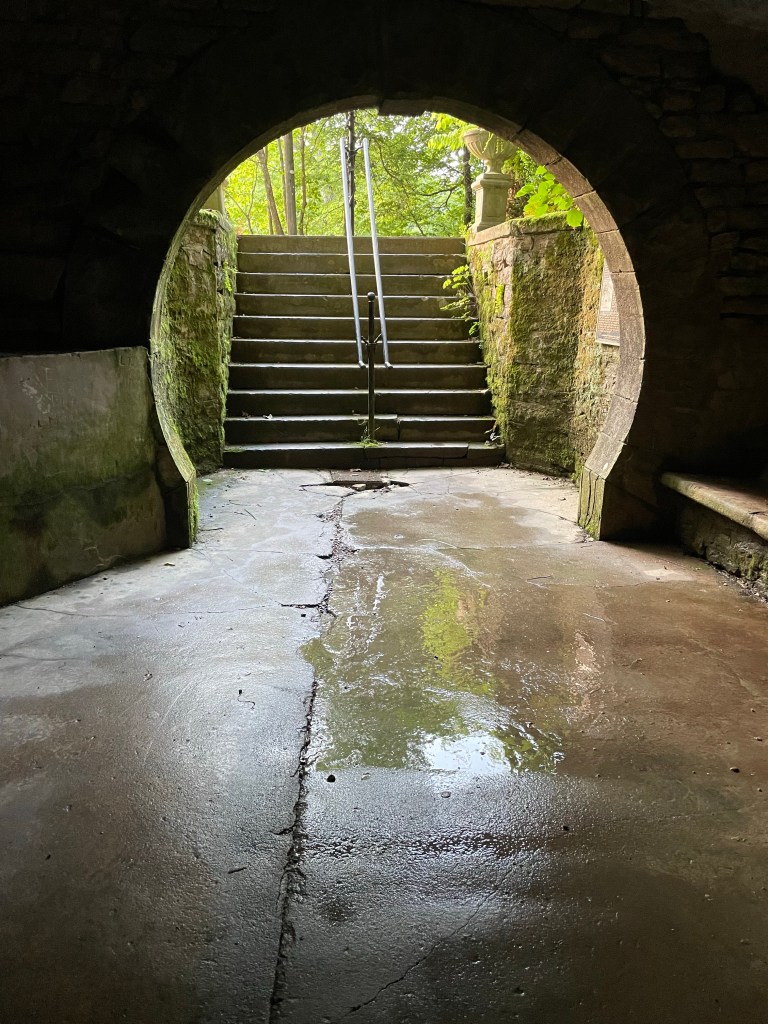
This beautiful spring reservation is a must-stop for visitors in cars or on the tour tram. Inside its natural cave — enhanced by a stone arch — the temperature is cool and there is almost always at least one candle burning in the darkness.
Though we are behind on rainfall right now, you can still see a damp floor where spring waters sometimes drip through. After a long gully-washer, this sub-grade spring will sometimes flood out.
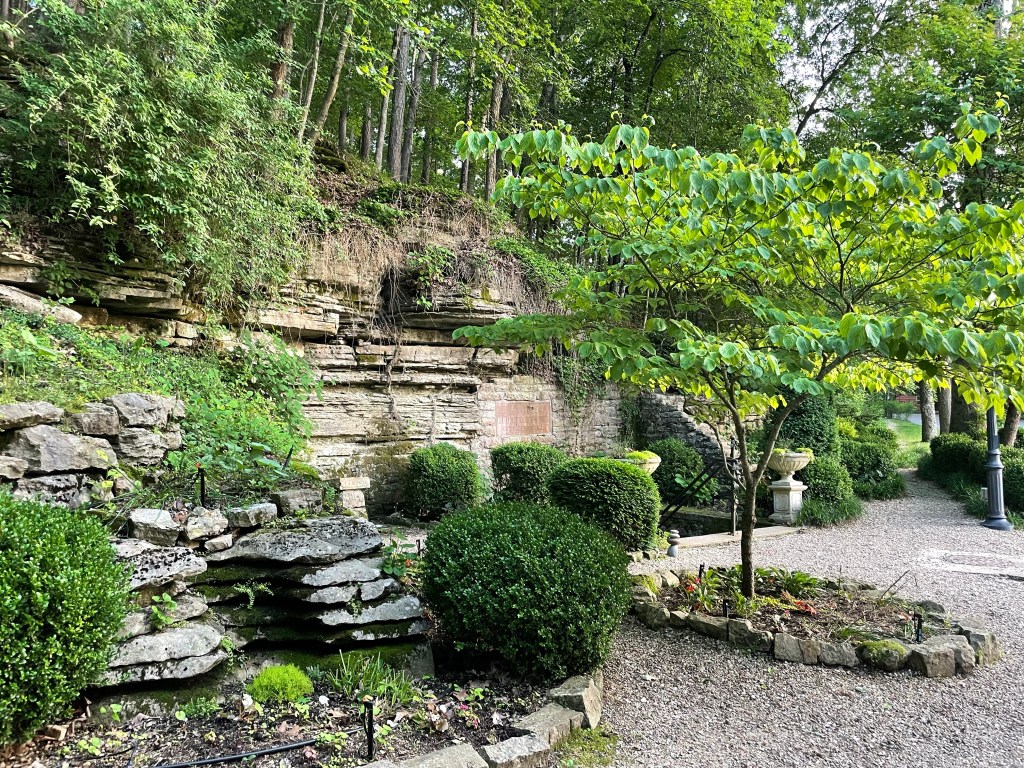
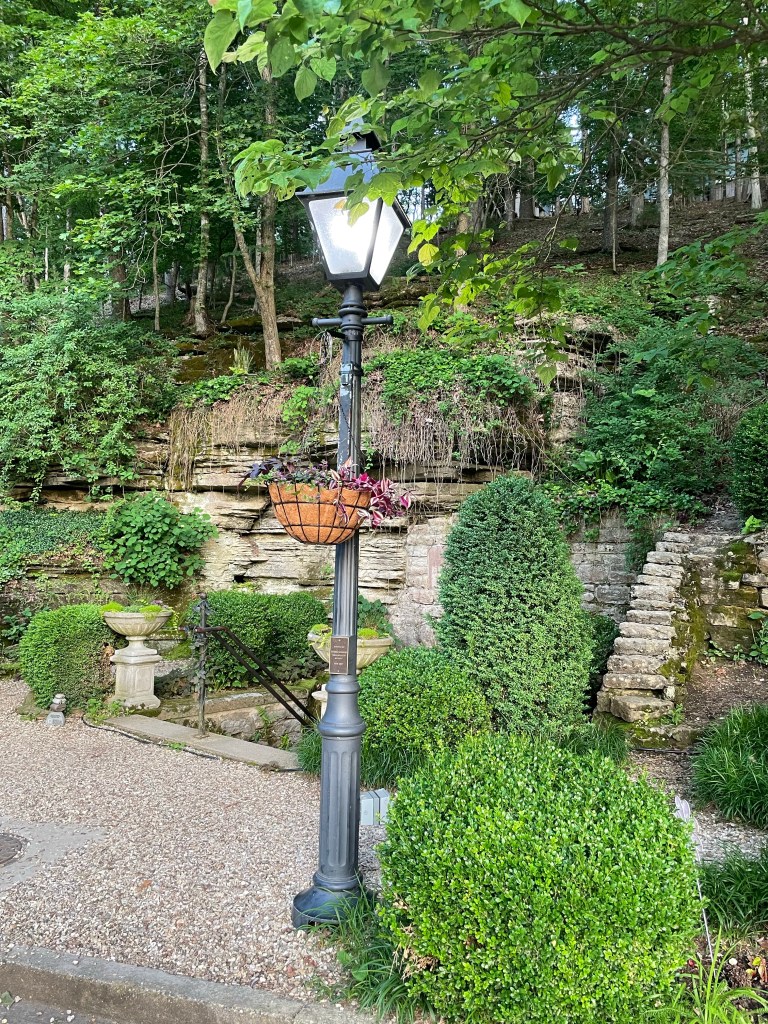
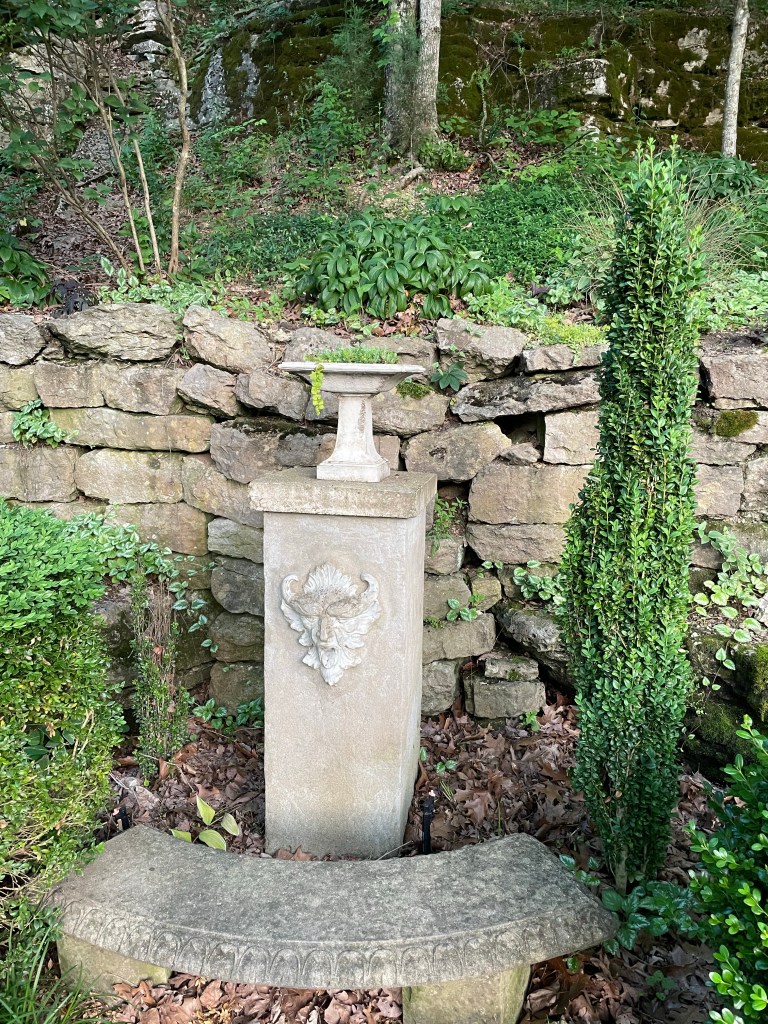
Approaching from the east.Grotto Spring is beautifully landscaped, like all the spring reservations. The arch and steps down to the springI have no idea who the keeper of the candle might be.The arch from the inside.Approaching from the west.A vintage -looking lamppost illuminates the reservation at night, matching those at other springs.A small bench and column on the west side. There is a concrete picnic table and benches on the east side, a feature common to many of the spring reservations.The view across the street from the spring at dusk.
Don’t laugh, now! A lot of Eureka Springs’ streets are staircases! Just don’t try to drive up and down them. For that, we have Mountain, Owen and Pine Streets, among others!
Cora Pinckley Call’s long-sold souvenir book, “A Stairstep Town” is aptly titled. I drew from her work, among many others, for historical information when writing “The People of the Waters.” I still do sometimes.
The top of Tibbs Alley at Center Street.It’s a bit of a steep climb!Closeup of the city’s descriptive plaque
I skipped Harding Spring! It resides on Spring Street between Sweet Spring and Crescent Spring, of course. A number of healings by water were reported here, including a rather famous one for blindness.
Harding Spring features the railed “lover’s leap” atop its steamboat rock, and a brand-new wooden staircase will take you to the top of it, and one of many enjoyable trails within our little city.
(Sorry that the marker is hard to read with the paper wasp nest on it.)
Steamboat rock and its lover’s leap. The spring is at the lower left.Approaching Harding Spring from the southHarding Spring can be heard running almost all year.The descriptive plaque is partially obscured by a wasp nest at present.
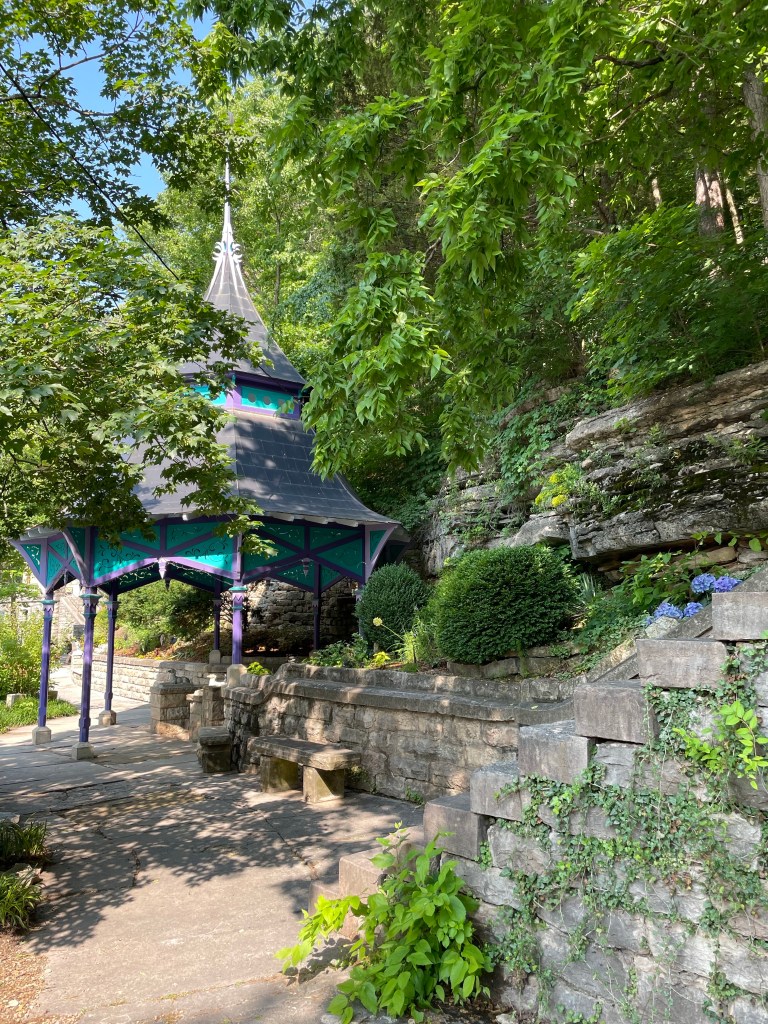
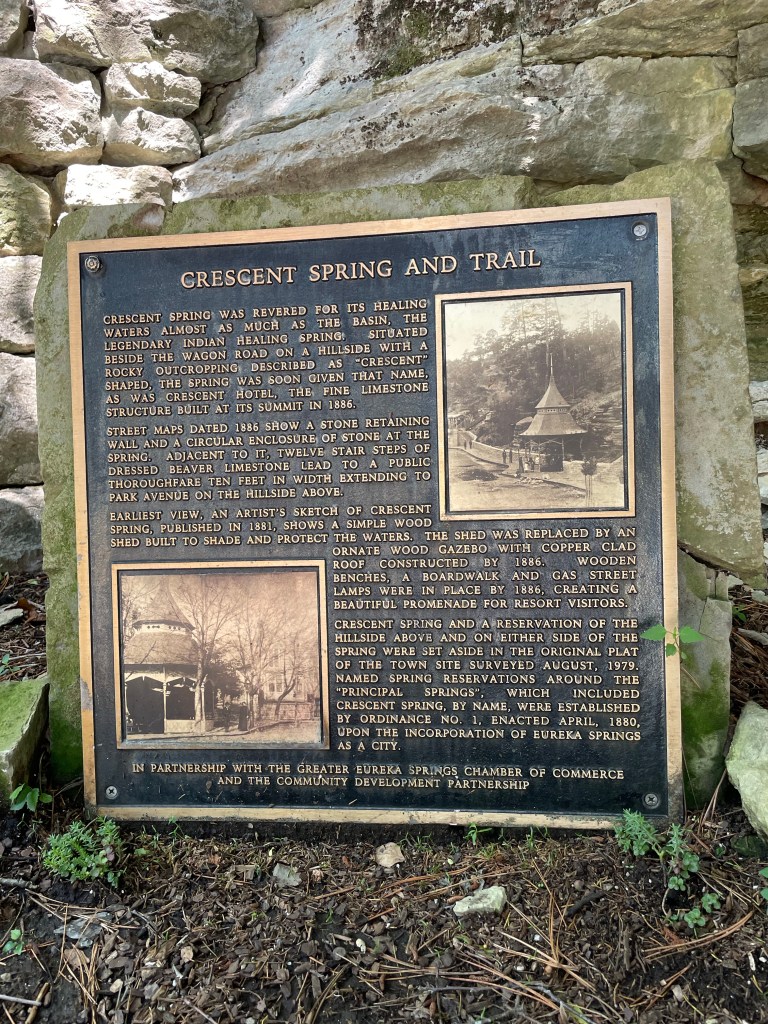
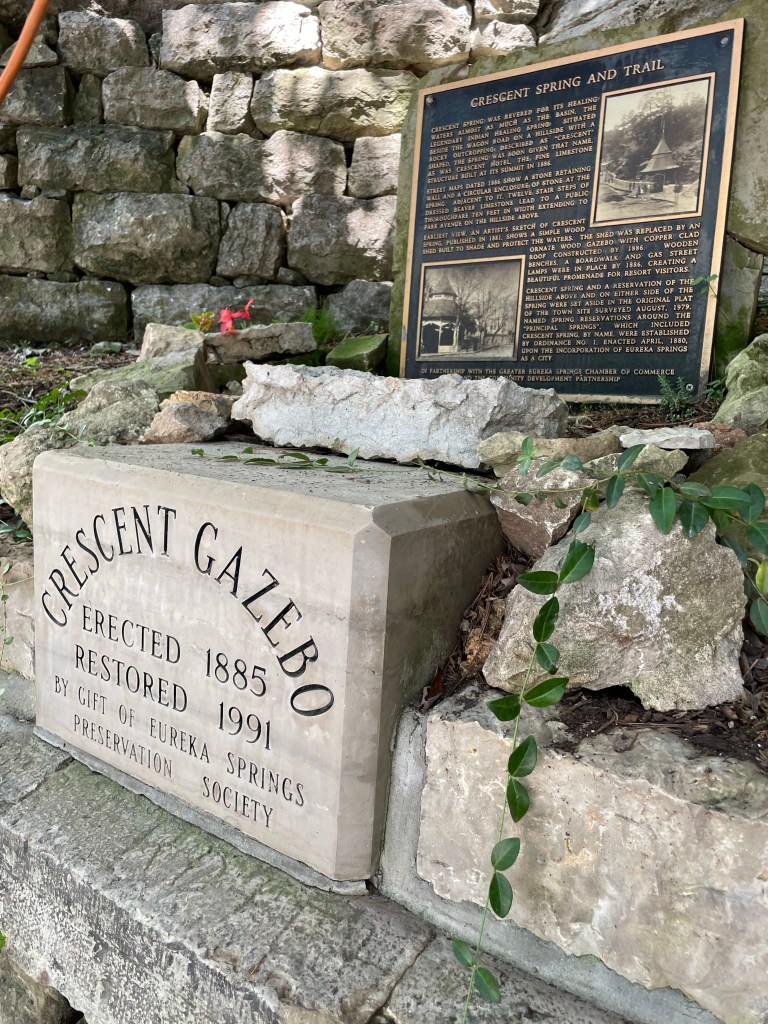
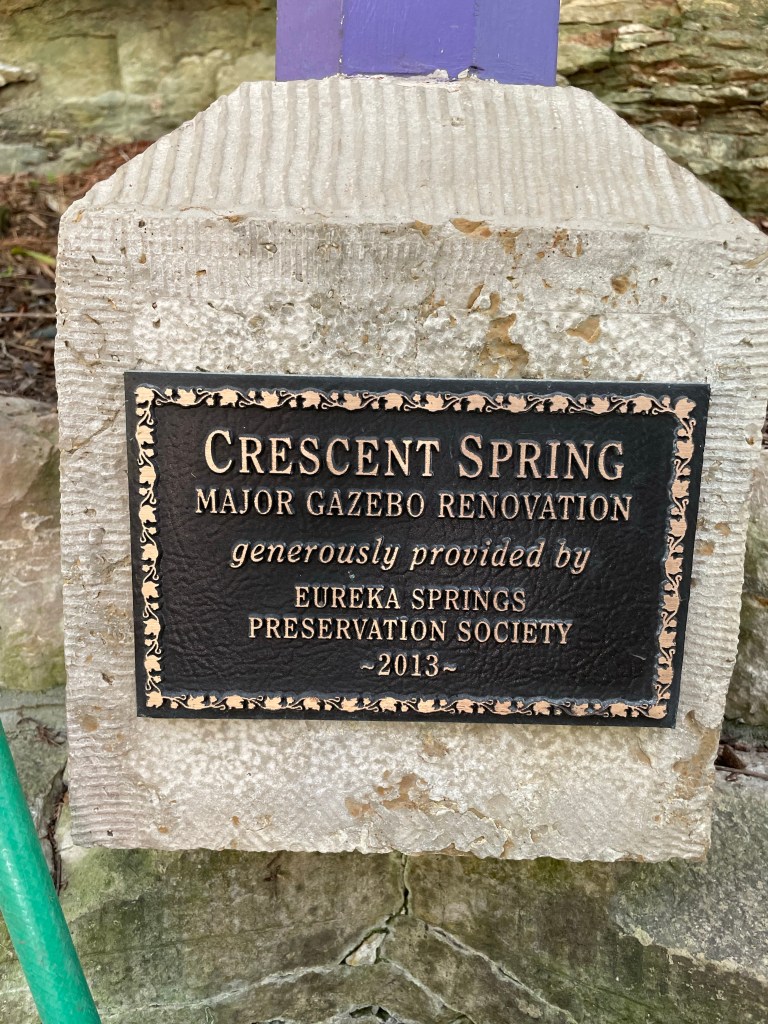
Crescent Spring is the next stop on our tour of Eureka’s spring reservations, set aside for public benefit early in the city’s history. This is the one for which Crescent Hotel is named, and you can still climb the stone steps up the hill to see that stately castle in the Ozarks. The current gazebo replaced the original one many decades after it had fallen into disrepair, and for many years was white with sage green trim. The current purple-and-aqua color scheme was applied in 2013 during a renovation. It features a copper roof, which has acquired a natural patina.
Crescent Spring gazebo hides behind trees as you approach it.But the reveal is entrancing.Historical marker records a capsule of the spring’s history.A stone marker complements the plaque.One of the pillars’ foundations recalls the gazebo renovation ten years ago.










 W. Keith Brenton